


Close


Interested in an amazing adventure?
Book Your Journey
Interested in an amazing adventure?
Book Your Journey
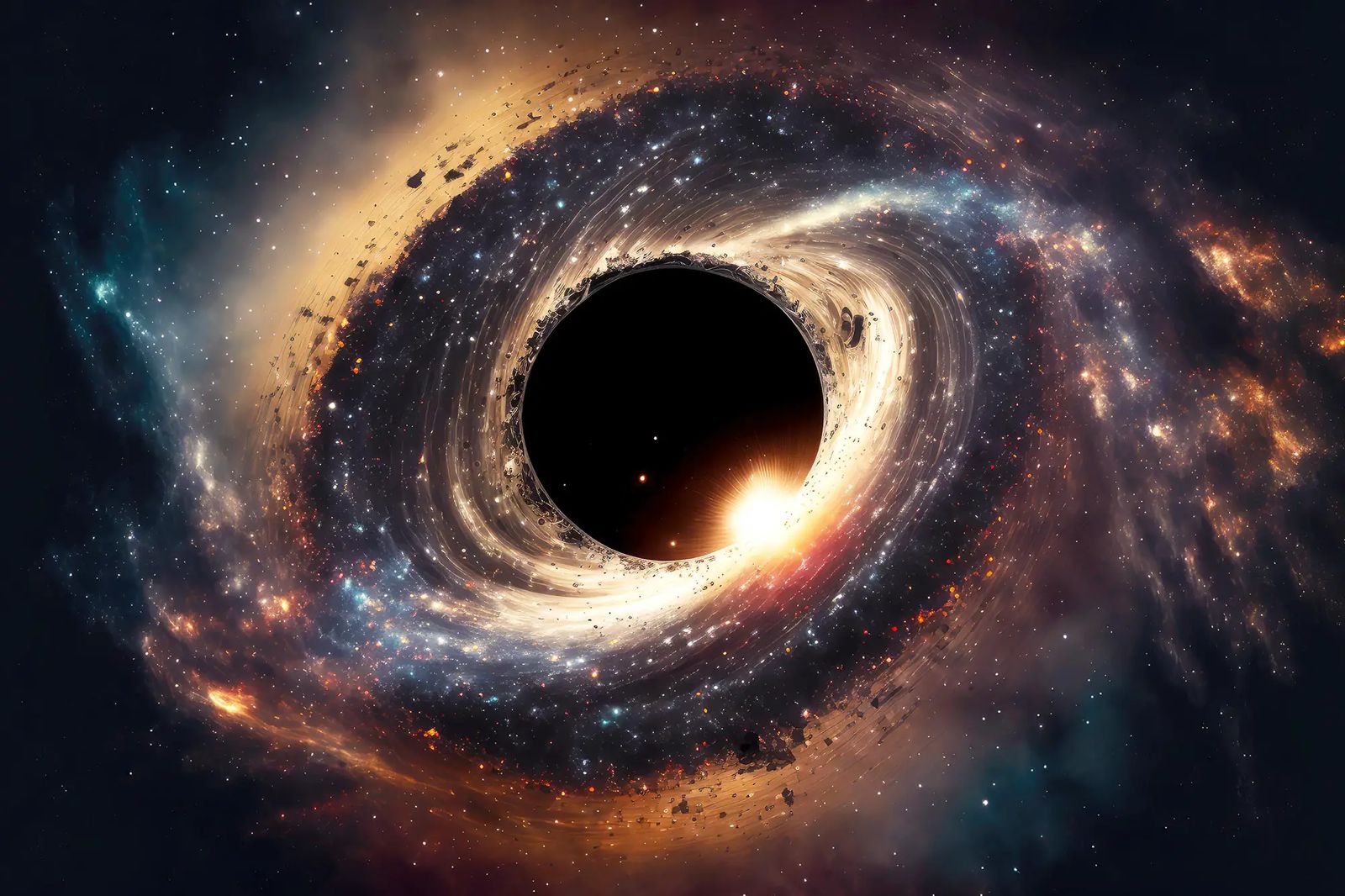
Black holes are among the most mysterious and extreme objects in the universe. They are often portrayed as cosmic vacuum cleaners that instantly destroy anything that comes near—but the reality is far more complex, and far more fascinating.
So what would actually happen if you fell into a black hole? Let’s break it down step by step using real physics.
A black hole is a region in space where gravity is so strong that nothing—not even light—can escape. This happens when a massive amount of matter is compressed into an extremely small space.
At the center lies the singularity, a point where density becomes infinite and the known laws of physics break down. Surrounding it is a boundary called the event horizon.
As you get closer to a black hole, gravity becomes increasingly intense. However, you might not notice anything unusual at first—especially if the black hole is very large.
From a distance, a black hole behaves like any other massive object. If our Sun were replaced with a black hole of the same mass, Earth would continue orbiting normally.
But as you approach, things start to change.
Near a black hole, gravity affects not only space—but also time. This is a consequence of General Relativity.
Time begins to slow down relative to an outside observer.
From your own perspective, however, time would feel normal.
As you get closer, the difference in gravitational pull between your feet and your head becomes extreme.
This effect is called spaghettification.
This happens because gravity is much stronger at the part of your body closer to the black hole.
For smaller black holes, this would happen before reaching the event horizon. For supermassive black holes, it might occur after crossing it.
The event horizon is the point of no return.
Once you cross it:
Interestingly, you wouldn’t feel anything special at the exact moment of crossing (especially for large black holes). There is no physical “surface”—just a boundary in spacetime.
Inside the black hole, all paths lead inward. Space and time effectively switch roles—you are forced to move toward the singularity the same way we are forced to move forward in time.
No known force can stop this.
Eventually, you would reach the singularity, where:
At this point, our current scientific understanding breaks down.
To someone watching from far away:
In other words, from their perspective, you would seem to freeze in time.
From your point of view:
Your journey would be finite—you would not feel “stuck” in time.
Realistically, no.
The combination of tidal forces, radiation (in some cases), and extreme gravity would destroy any known form of matter.
Even advanced spacecraft would not survive the journey.
Black holes are not just theoretical—they play a major role in the universe:
Studying black holes helps us understand gravity, spacetime, and the limits of physics.
Falling into a black hole is one of the most extreme scenarios imaginable. It combines the strangest effects of gravity, time, and space into a single event.
While it’s not something we’ll experience firsthand, studying it gives us deeper insight into how the universe works.
Black holes are not just destructive—they are one of the keys to understanding the fundamental laws of nature.
✓ Success


.jpg)