


Close


Interested in an amazing adventure?
Book Your Journey
Interested in an amazing adventure?
Book Your Journey
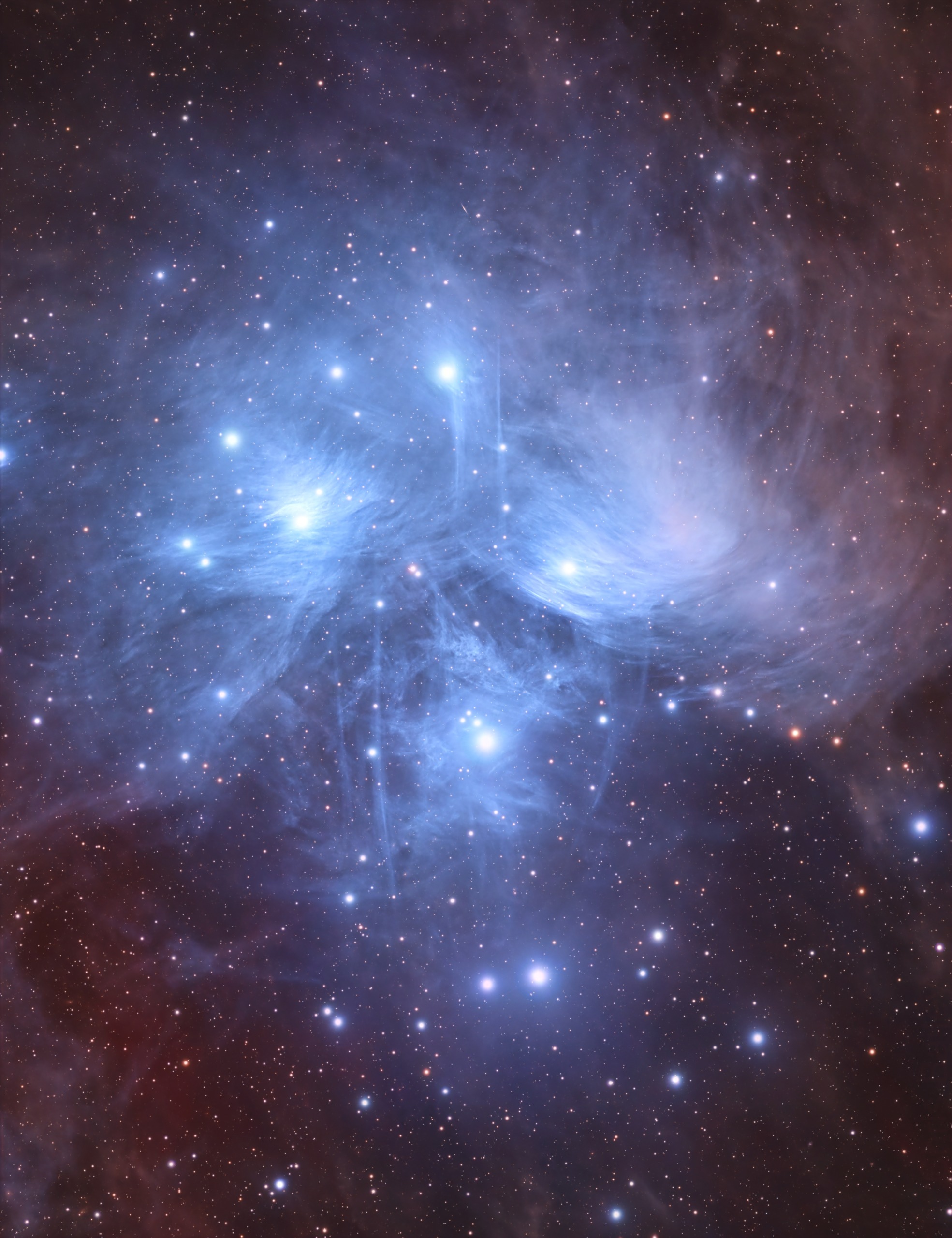
The Pleiades star cluster, known in Arabic as Al Thurayya, is one of the nearest and most
recognizable open clusters in the night sky. Composed of young, hot stars, it is embedded within
a faint veil of interstellar dust that reflects their light, producing the characteristic blue glow seen
in deep imaging.
Unlike emission nebulae, this luminosity is not generated by ionization, but by reflection. Fine
dust particles scatter the starlight, revealing the structure of the surrounding medium without
altering its energy. This interaction creates a soft, diffuse appearance, where the boundaries
between stars and nebula are subtle and continuous.
High-resolution observation reveals intricate filamentary patterns within the dust, shaped by the
motion of the cluster through the interstellar medium. These structures trace the interaction
between stellar radiation, magnetic fields, and surrounding material, offering insight into the
early environment of stellar systems.
Historically, Al Thurayya has held deep significance across cultures, serving as a seasonal
marker and a point of reference in navigation and timekeeping. Its presence connects
observational astronomy with human history, where the same cluster has guided both scientific
study and cultural understanding.
Here, it is presented not only as a collection of stars, but as a system where light, dust, and
motion converge, revealing both physical structure and enduring relevance.
Total Integration Time: 10 Hours
Captured from Al Sadeem Observatory by Al Sadeem Astronomy
✓ Success