


Close


Interested in an amazing adventure?
Book Your Journey
Interested in an amazing adventure?
Book Your Journey
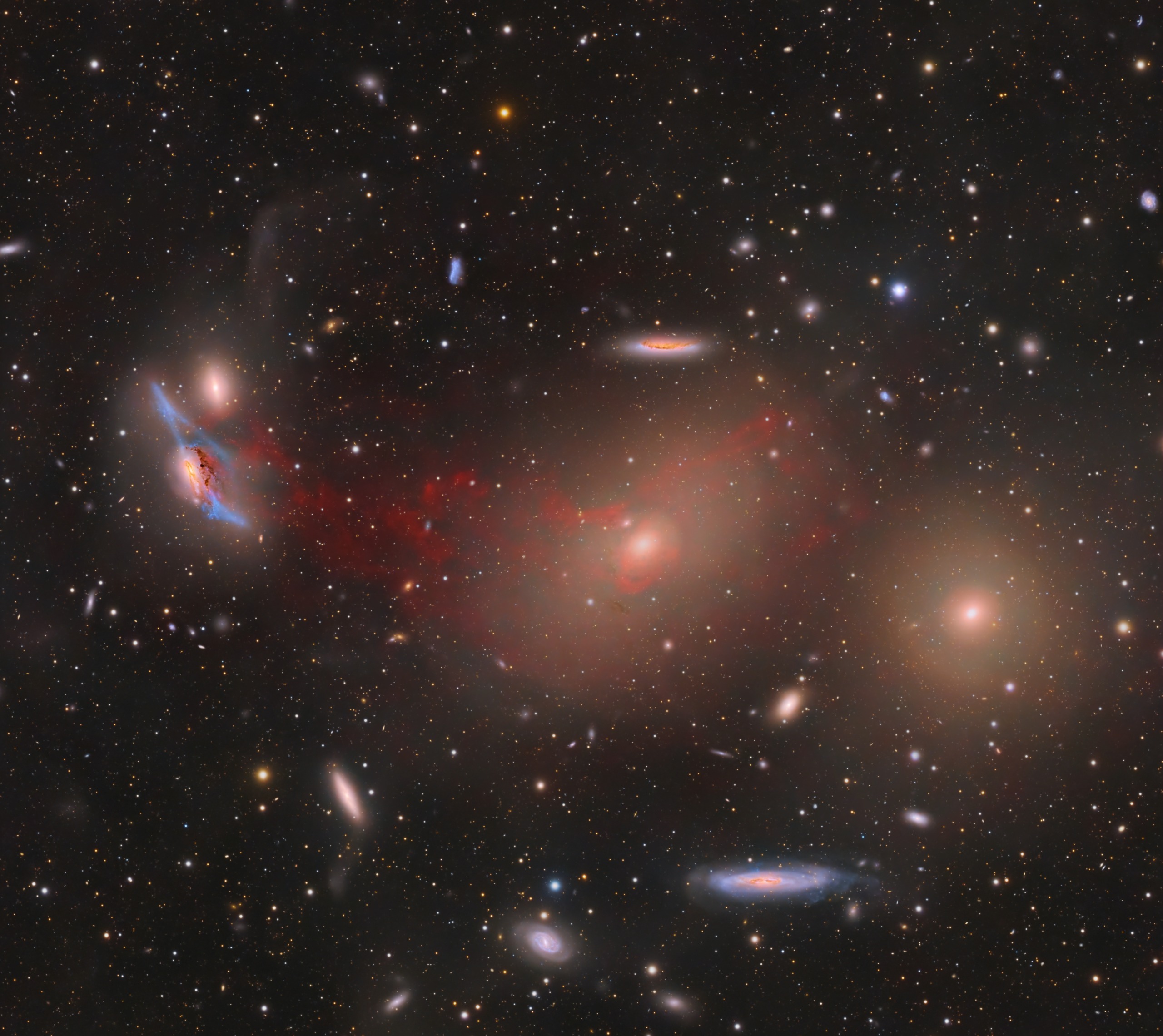
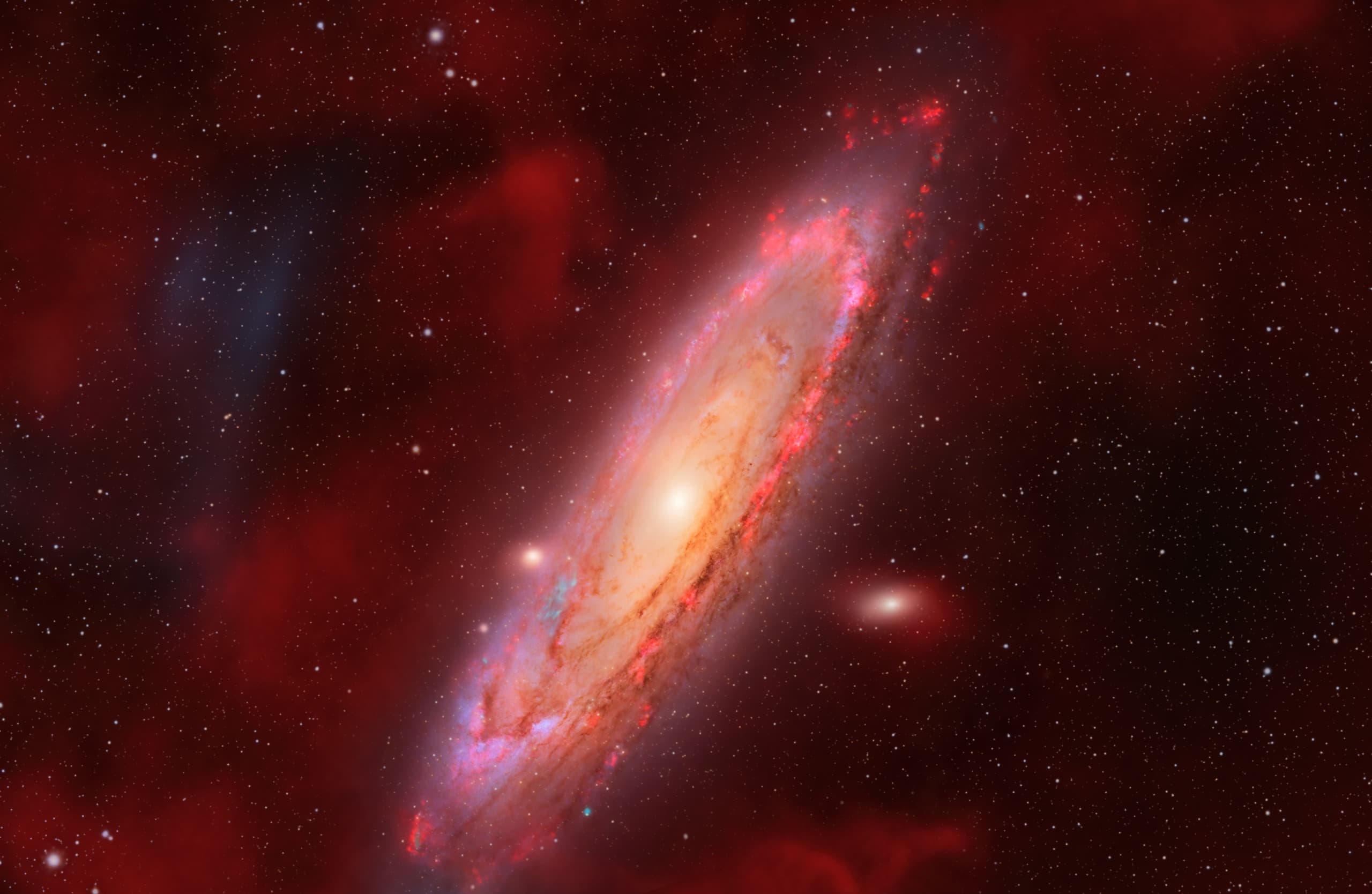
This field captures a section of the Virgo Cluster, one of the nearest and most dynamically active
galaxy clusters. Beyond the distribution of galaxies, the image reveals extended hydrogen-alpha
(Hα) emission tracing material beyond galactic boundaries.
These filaments are not typical star-forming regions. Their structure and lack of associated
stellar light indicate gas that has been removed from galaxy disks and displaced into the
intracluster medium. This process, known as ram-pressure stripping, occurs as galaxies move
at high velocities through the hot, diffuse plasma of the cluster environment.
As galaxies interact with this medium, their interstellar gas is stripped away, forming extended
filaments and tails that can span tens of kiloparsecs. The observed Hα emission traces ionized
hydrogen within these structures, revealing the redistribution of material that would otherwise
contribute to future star formation.
This behavior is consistent with well-documented cases such as NGC 4522, where extraplanar
gas and displaced star-forming regions have been observed under similar conditions. The
absence of corresponding stellar populations in parts of these filaments further supports their
origin as stripped interstellar medium rather than in-situ formation.
The result is a direct observational signature of environmental galaxy evolution. Within cluster
environments, galaxies do not evolve in isolation. Their gas content, morphology, and future
star-forming potential are shaped by continuous interaction with the surrounding medium.
This field presents that process in action, where structure is not only defined by gravity, but by
motion through an active and transformative environment.
Total Integration Time: 100 hours
Captured from Al Sadeem Observatory by Al Sadeem Astronomy